Imaging

Last 50 Imaging Postings

(Most recent listed first. Click on title to be directed to the manuscript.)

August 2025 Medical Image of the Month: Crazy Paving in a Case of 
   Eosinophilic Granulomatosis with Polyangiitis
July 2025 Medical Image of the Month: A Case of Severe Hiatal Hernia
   Presenting as Atypical Chest Pain
July 2025 Imaging Case of the Month: A Growing Lung Nodule in a
   Patient with Heart Disease
June 2025 Medical Image of the Month: Neurofibromatosis-Associated Diffuse
   Cystic Lung Disease
May 2025 Medical Image of the Month: Aspirated Dental Screw
April 2025 Medical Image of the Month: An Unfortunate Case of Mimicry
March 2025 Medical Image of the Month: An Unusual Case of Pulmonary
   Infarction
February 2025 Medical Image of the Month: Unexpected Complications of
   Transjugular Intrahepatic Portosystemic Shunt (TIPS) 
February 2025 Imaging Case of the Month: A Wolf in Sheep’s Clothing
January 2025 Medical Image of the Month: Psoriasis with Pulmonary
   Involvement
December 2024 Medical Image of the Month: An Endobronchial Tumor
November 2024 Medical Image of the Month: A Case of Short Telomeres
November 2024 Imaging Case of the Month: A Recurring Issue
October 2024 Medical Image of the Month: Lofgren syndrome with Erythema
   Nodosum
September 2024 Medical Image of the Month: A Curious Case of Nasal
   Congestion
August 2024 Image of the Month: Lymphomatoid Granulomatosis
August 2024 Imaging Case of the Month: An Unexplained Pleural Effusion
July 2024 Medical Image of the Month: Vocal Cord Paralysis on PET-CT 
June 2024 Medical Image of the Month: A 76-year-old Man Presenting with
   Acute Hoarseness
May 2024 Medical Image of the Month: Hereditary Hemorrhagic
   Telangiectasia in a Patient on Veno-Arterial Extra-Corporeal Membrane
   Oxygenation
May 2024 Imaging Case of the Month: Nothing Is Guaranteed
April 2024 Medical Image of the Month: Wind Instruments Player Exhibiting
   Exceptional Pulmonary Function
March 2024 Medical Image of the Month: Sputum Cytology in Patients with
   Suspected Lung Malignancy Presenting with Acute Hypoxic Respiratory
   Failure
February 2024 Medical Image of the Month: Pulmonary Alveolar Proteinosis
   in Myelodysplastic Syndrome
February 2024 Imaging Case of the Month: Connecting Some Unusual Dots
January 2024 Medical Image of the Month: Polyangiitis Overlap Syndrome
   (POS) Mimicking Fungal Pneumonia 
December 2023 Medical Image of the Month: Metastatic Pulmonary
   Calcifications in End-Stage Renal Disease 
November 2023 Medical Image of the Month: Obstructive Uropathy
   Extremis
November 2023 Imaging Case of the Month: A Crazy Association
October 2023 Medical Image of the Month: Swyer-James-MacLeod
   Syndrome
September 2023 Medical Image of the Month: Aspergillus Presenting as a
   Pulmonary Nodule in an Immunocompetent Patient
August 2023 Medical Image of the Month: Cannonball Metastases from
   Metastatic Melanoma
August 2023 Imaging Case of the Month: Chew Your Food Carefully
July 2023 Medical Image of the Month: Primary Tracheal Lymphoma
June 2023 Medical Image of the Month: Solitary Fibrous Tumor of the Pleura
May 2023 Medical Image of the Month: Methamphetamine Inhalation
   Leading to Cavitary Pneumonia and Pleural Complications
April 2023 Medical Image of the Month: Atrial Myxoma in the Setting of
   Raynaud’s Phenomenon: Early Echocardiography and Management of
   Thrombotic Disease
April 2023 Imaging Case of the Month: Large Impact from a Small Lesion
March 2023 Medical Image of the Month: Spontaneous Pneumomediastinum
   as a Complication of Marijuana Smoking Due to Müller's Maneuvers
February 2023 Medical Image of the Month: Reversed Halo Sign in the
   Setting of a Neutropenic Patient with Angioinvasive Pulmonary
   Zygomycosis
January 2023 Medical Image of the Month: Abnormal Sleep Study and PFT
   with Supine Challenge Related to Idiopathic Hemidiaphragmatic Paralysis
December 2022 Medical Image of the Month: Bronchoesophageal Fistula in
   the Setting of Pulmonary Actinomycosis
November 2022 Medical Image of the Month: COVID-19 Infection
   Presenting as Spontaneous Subcapsular Hematoma of the Kidney
November 2022 Imaging Case of the Month: Out of Place in the Thorax
October 2022 Medical Image of the Month: Infected Dasatinib Induced
   Chylothorax-The First Reported Case 
September 2022 Medical Image of the Month: Epiglottic Calcification
Medical Image of the Month: An Unexpected Cause of Chronic Cough
August 2022 Imaging Case of the Month: It’s All About Location
July 2022 Medical Image of the Month: Pulmonary Nodule in the
   Setting of Pyoderma Gangrenosum (PG) 
June 2022 Medical Image of the Month: A Hard Image to Swallow
May 2022 Medical Image of the Month: Pectus Excavatum
May 2022 Imaging Case of the Month: Asymmetric Apical Opacity–
   Diagnostic Considerations
April 2022 Medical Image of the Month: COVID Pericarditis
March 2022 Medical Image of the Month: Pulmonary Nodules in the
   Setting of Diffuse Idiopathic Pulmonary NeuroEndocrine Cell Hyperplasia
   (DIPNECH) 
February 2022 Medical Image of the Month: Multifocal Micronodular
   Pneumocyte Hyperplasia in the Setting of Tuberous Sclerosis
February 2022 Imaging Case of the Month: Between A Rock and a
   Hard Place


For complete imaging listings click here

Those who care for patients with pulmonary, critical care or sleep disorders rely heavily on chest radiology and pathology to determine diagnoses. The Southwest Journal of Pulmonary, Critical Care & Sleep publishes case-based articles with characteristic chest imaging and related pathology. The editor of this section will oversee and coordinate the publication of a core of the most important chest imaging topics. In doing so, they encourage the submission of unsolicited manuscripts. It cannot be overemphasized that both radiologic and pathologic images must be of excellent quality. As a rule, 600 DPI is sufficient for radiographic and pathologic images. Taking pictures of plain chest radiographs and CT scans with a digital camera is strongly discouraged. The figures should be cited in the text and numbered consecutively. The stain used for pathology specimens and magnification should be mentioned in the figure legend. Those who care for patients with pulmonary, critical care or sleep disorders rely heavily on chest radiology and pathology to determine diagnoses. The Southwest Journal of Pulmonary, Critical Care & Sleep publishes case-based articles with characteristic chest imaging and related pathology. The editor of this section will oversee and coordinate the publication of a core of the most important chest imaging topics. In doing so, they encourage the submission of unsolicited manuscripts. It cannot be overemphasized that both radiologic and pathologic images must be of excellent quality. As a rule, 600 DPI is sufficient for radiographic and pathologic images. Taking pictures of plain chest radiographs and CT scans with a digital camera is strongly discouraged. The figures should be cited in the text and numbered consecutively. The stain used for pathology specimens and magnification should be mentioned in the figure legend.

-------------------------------------------------------------------------------------------  

Entries in Pancreatitis (4)

Friday
Jan112013

Medical Image of the Week: Hypertriglyceridemia-induced Pancreatitis

Figure 1. Panel A. Abdominal CT scan showing pancreatitis with edema and indistinct pancreatic borders (arrows). Panel B. Patient’s milky serum sample from elevated triglycerides. 

A 38 year old man presented with diffuse abdominal pain and was found to have pancreatitis on abdominal CT image (Figure 1, Panel A). His triglyceride level was 4573 mg/dL and his serum red top tube was visibly lipemic (Figure 1, Panel B).  He underwent one cycle of plasmapheresis and his triglyceride level decreased to below 500mg/dL.

Nathaniel Reyes, MD and Gordon Carr, MD

Division of Pulmonary and Critical Care Medicine

Arizona Respiratory Center

University of Arizona

Tucson, AZ

Reference as: Reyes N, Carr G. Medical image of the week: hypertriglyceridemia-induced pancreatitis. Southwest J Pulm Crit Care 2013;6(1):22. PDF

Friday
Jun032011

Ground-Glass Opacities

Reference as: Gopal V, Robbins RA. Ground-glass opacities. Southwest J Pulm Crit Care 2011;2:67-70. (Click here for PDF version)

A 54-year-old male was admitted to the medical intensive care unit complaining of abdominal pain, nausea, and vomiting for 2 days. He had a past medical history of pancreatitis in 2009, treated as outpatient, and asthma treated with albuterol inhaler as needed. His medication list included gemfibrizol, gabapentin, and amitriptyline. He drank 6-8 beers per day and smoked 1 pack-per-day for the past 40 years.

On physical examination is the patient was afebrile, his lungs are clear to auscultation, but tenderness was present in both lower quadrants. The remainder of the physical examination was normal.

Laboratory examination revealed a normal complete blood count and normal basic metabolic panel. Abnormal laboratory values included an elevated total bilirubin of 2.7 mg/dL (normal 0.2-1 mg/dL); alkaline phophatase 169 U/L (normal 10-40 U/L);  alanine aminotransferase 286 U/L (normal 10-35 U/L); amylase 468 U/L (normal 25-125 U/L), and lipase 1580 U/L (normal 8-78 U/L). Arterial blood gasmeasurements showed PaO2 = 91 mm Hg, PaCO2 = 26 mm Hg, pH = 7.52, and oxygen saturation = 98% while breathing room air.

Chest radiography (Figure 1, Panel A) was interpreted as showing a “right upper lobe infiltrate which could represent an acute pneumonia”.  No distinct abnormalities were identified on abdominal radiographs (Figure 1, Panel B).
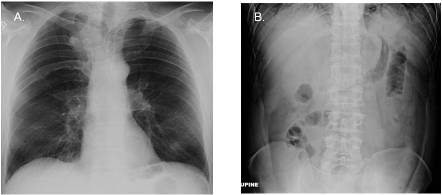
 

 Figure 1. Panel A. Frontal chest radiography.  Panel B. Abdominal radiography.

To further evaluate the possibility of a right upper lobe abnormality at chest radiography, thoracic CT was performed and as showing patchy ground-glass opacities throughout the lungs bilaterally (Figure 2).
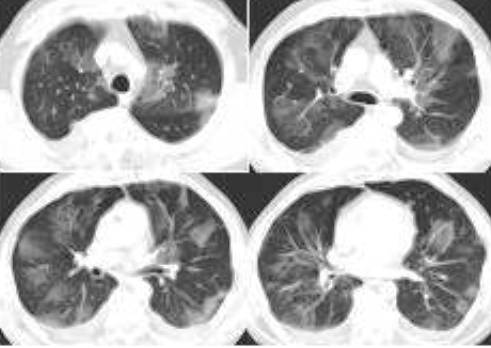
Figure 2. Representative images from thoracic CT.

Question 1. What’s the most likely diagnosis?

  1. Hypersensitivity pneumonitis
  2. Acute inhalational injury secondary to “huffing”.
  3. Drug-induced lung disease
  4. Valley Fever
  5. Ground-glass opacities associated with pancreatitis

Question 2. What would you do next?

  1. Hypersensitivity panel
  2. Bronchoscopy with bronchoalveolar lavage
  3. Begin Diflucan
  4. Broaden his antibiotic coverage
  5. Repeat the thoracic CT scan in 3-4 days.

The thoracic CT was repeated four days later and the ground-glass opacities seen previously had largely resolved (Figure 3).
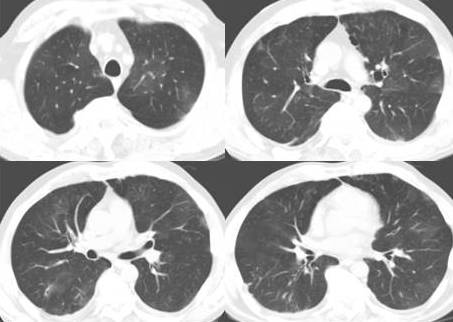
Figure 3.  Representative images from thoracic CT performed four days following the initial study Figure 2).

These ground-glass opacities likely represent subclinical non-cardiogenic pulmonary edema in the setting of acute pancreatitis. Ground-glass opacities are foci of increased lung attenuation that do not obscure underlying vessels or bronchial margins (1). Ground-glass opacities often represent parenchymal abnormalities below the spatial resolution of high-resolution CT of the lung. Although the differential diagnosis of ground-glass opacities at high-resolution CT is large, these etiologies may be broadly divided into acute or chronic causes. Table 1 lists some of the more common causes of ground-glass opacities at high-resolution CT.

Table 1: Common Etiologies for Ground-Glass Opacity at Thoracic CT

Acute

Chronic

Pulmonary edema (cardiogenic or non-cardiogenic)

Interstitial diseases (hypersensitivity pneumonitis, desquamative interstitial pneumonia, respiratory bronchiolitis-interstitial lung disease, nonspecific interstitial pneumonia, sarcoidosis, others)

Infectious pneumonitis (PJP, CMV, HSV, RSV, others)

Bronchoalveolar carcinoma

Noninfectious pneumonitis (hypersensitivity pneumonitis, acute inhalational exposures, drug-induced lung diseases)

Other causes (drug toxicity, pulmonary alveolar proteinosis, organizing pneumonia, chroic eosinophilic pneumonia, others)


Our patient had no apparent cause, other than subclinical non-cardiogenic pulmonary edema secondary to pancreatitis. Pulmonary edema is a well known complication of pancreatitis and can be severe (2). It seems likely that, as more sensitive methods for the detection of pulmonary abnormalities, such as thoracic CT, are increasingly applied to patients with pancreatitis, that subclinical pulmonary injury may be increasingly detected.

Venu Gopal, M.D.

Chief, Infectious Disease, Phoenix VA Medical Center


Richard A. Robbins, M.D.

Chief, Pulmonary and Critical Care, Phoenix VA Medical Center


Slide Set


References

  1. Miller WT Jr, Shah RM.  Isolated diffuse ground-glass opacity in thoracic CT: causes and clinical presentations.  AJR Am J Roentgenol 2005;184:613-22.
  2. Raghu MG, Wig JD, Kochhar R, Gupta D, Gupta R, Yadav TD, Agarwal R, Kudari AK, Doley RP, Javed A. Lung complications in acute pancreatitis. JOP. 2007;8:177-85.

Page 1 2